

Meteorological Instruments

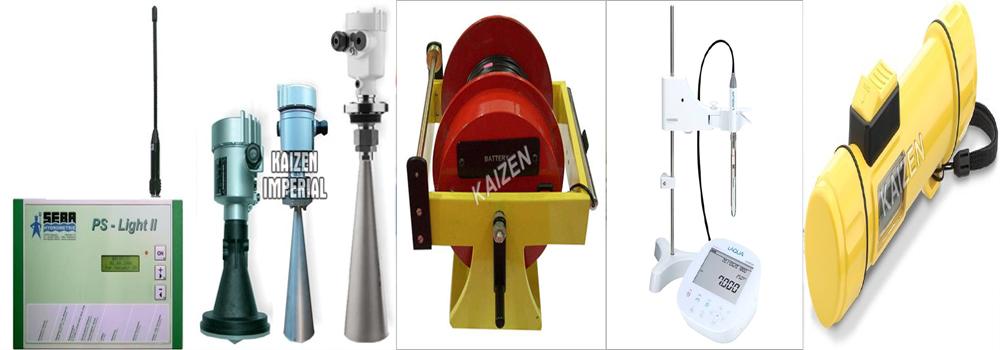
Studying the weather requires the use of equipment called the Meteorological Instruments that can measure things like wind direction, humidity, atmospheric pressure, solar radiation, rainfall, temperature, wind speed, evaporation rate, and more.

Soil Testing Instruments

Kaizen Imperial provides a complete offering of Lab testing devices for Soil, from basic Soil Grinders to complex Testing Equipment. Our product line includes tests for Double Ring Soil Infiltrometer, Soil Moisture Meter, Soil Temperature, Humidity Recorder and Soil Tensiometer.

Hydrological Instruments

Kaizen imperial is a devoted manufacturer, exporter and supplier of hydrological instruments that are manufactured using cutting edge technology. Kaizen’s engineer makes use of qualitative raw materials for the production of muffle furnace that ensure high quality and performance.

Laboratory instruments

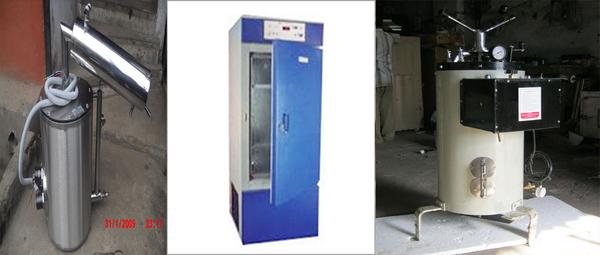
Kaizen imperial is a leading manufacturers, suppliers and exporters of laboratory instruments. Not only within the zone but also beyond overseas,we have marked our foots as a tough companion. Our array includes Laboratory Incubator, Laboratory Water Bath, Laboratory Ball Mill,Vertical Autoclave and more.

Oil and Petroleum Testing Instruments

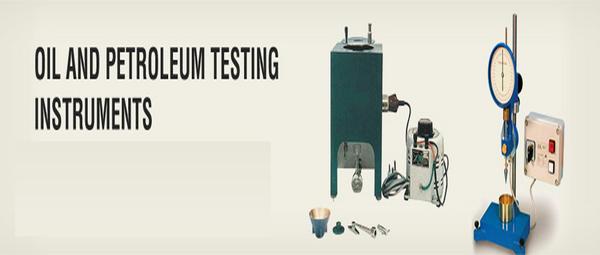
Kaizen manufacture petroleum test equipment and quality control instruments used to measure the physical characteristics that determine product quality and firmness.

Monday, 30 October 2017

How to use the Penetrometer

The readings taken with the penetrometer are called the cone index. The readings should be taken when the whole profile is at field capacity (approximately 24 hours after a soaking rain). The best time of the year for the compaction measurement is the spring because the whole profile has usually been thoroughly moistened during the winter. If the soil is too wet (muddy), compaction could be underestimated because the soil acts as a liquid. If the soil is too dry, compaction could be overestimated because roots will be able to penetrate the soil when it dampens. The idea behind using the penetrometer at field capacity is that this is the best-case scenario for roots. Hopefully, the soil will be at field capacity at various times during the growing season. During these periods, roots will be able to penetrate soil that has low penetration resistance. Penetration resistance will increase when the soil dries out, and root growth can then be expected to be limited. However, when the moisture content of the soil increases again, penetration resistance will decrease, and root growth will resume.

The penetrometer rod should be driven in the soil at a rate of approximately 1 inch per second. As you push the penetrometer into the soil, record the depth at which the 300 psi level is exceeded, using the gradients on the penetrometer rod. This level is the top of the compacted zone. Continue pressing the penetrometer down. Record the depth at which the penetration falls below 300 psi. This is the bottom of the compacted zone. For each measuring point, there are two numbers: the top of the compaction zone and the bottom of the compaction zone. If penetration resistance never increases above 300 psi, you will have blanks in both spaces, indicating no severe root-limiting compaction. If the penetration resistance increases above 300 psi, but never falls below 300 psi, there is no bottom to the compaction zone.

Cone index should be measured respective to tillage relief, wheel tracks, plant rows, and other recognizable patterns in the field. For example, if you know the areas of wheel traffic, take transects in and out of the track, and report them separately. If there are subsoiled zones in the field, measure penetration resistance in and out of the subsoiled zone. If there are planted rows, take measurements in and between the rows, and report them separately. Take separate readings for trafficked and non-trafficked areas.

The number of readings in a field depends on the accuracy you desire. As a first approximation, take some preliminary readings at a few places in the field to develop a sampling strategy. The cone index values are likely to be quite variable, so multiple readings are required per field. It is


Recommended to take one reading every 100 to 150 feet, or three to four readings per acre to develop a solid recommendation. This is a useful spacing if no recognizable patterns are present.


Interpretation of penetration resistance measurements.

Percentage of measuring points having cone index > 300 psi in top 15 inches
Compaction rating
Subsoiling recommended
<30
Little-none
No
30-50
Slight
No
50-75
Moderate
Yes
>75
Severe
Yes


Saturday, 23 August 2014

Meteorological Station- Weather Monitoring System

Forecasting of weather and environmental conditions has become an essential part of human life for different motives such as agriculture, construction and safety from natural disasters. There is a plenty of devices available for measuring weather related data base and they are used by different industries for respective reasons.  Automatic weather station is generally located on flat area rather than placing on buildings, trees etc. These stations are located by many industries at different places to know respective results as in Observing stations are set up the universities for training the students and to make them analyze weather data and course assignment, on the other hand, meteorological stations are used by weather analysts with the purpose of forecasting atmospheric conditions. Meteorological Instruments are used by farmers as well for the plantation of crops or for crop irrigation.

Many types of tool with different features are available in the industry to be used effectively to solve a large number of arrays of situations. The main purpose of such instruments is to predict the state of future weather for particular location. Collection of data is the most essential part for prediction or forecast of the weather. Weather stations determine the measurement of temperature, humidity and wind which helps in knowing how the atmosphere evolves in the future. The locations where meteorological data is collected are known as observing sites or observing stations. These weather stations usually have self-contained weather monitoring systems those are used either by an individual or non-commercial organization. These stations are available in wired and wireless versions. Analysts who seek for reliability of data collection often use wired weather station, such stations need battery power to run the sensors.

Handheld Digital Anemometer is the other instrument used for wind measurement instead of weather station. These products are absolutely light weighted, portable and extremely durable. They are designed as a self-contained device without extensions, cables or tubes. The database is easy to read and accurate therefore, these instruments just because of few qualities are considered ideal for wind measurement.
Meteorological stations are the best sources to create observations of atmospheric conditions with the help of some equipment and instruments. Through these stations, manual observation is supposed to be taken once in a day on the contrary, automated observation is taken almost every hour.
There are several advantages of these stations respectively depending on the industry by which they are used. Weather analysts are able to see weather readings from indoor whenever they require and these readings are easy to collect from the console panel. These stations are able to analyze and collect statistics automatically and the display is impressive as it is visual graphic.

There are many Industries indulged in installing or buying such Automatic Weather Stations as Educationists use weather monitoring as part of their practical course curriculum joining science, data handling, geography and many more. The weather websites are even useful for the people who are interested in outdoor activities such as flying, rafting, surfing, sailing etc. to alert them before they leave home if atmospheric conditions are getting worse. Weather analysis provides important practical data, temperature, and soil moisture to farmers or horticulturists to take decision in terms of pest control, crop irrigation etc. Scientists also use these weather observing instruments for their research.


Thursday, 31 July 2014

Scientific Instruments - Kaizen Imperial

Since its establishment in the year 2007, Kaizen imperial has grown to become a major company and is recognized globally in pursuit of world-class scientific instruments and Laboratory Equipments export and as a progressing Manufacturer.  Kaizen imperial is an ISO 9001:2008 Quality System Certified Organization. It deals in exporting its production to several countries.

The company has a record of working with new technologies and has always produced new innovative products that assured its existence at the forefront. We guarantee the quality and reliability of the products to suit the demanding applications. The company employs highly qualified engineers and scientists focused on quality products. Kaizen imperial has been appreciated for its manufacturing of superior quality instruments and equipments which comply with some of the most stringent dimensional specifications across the globe. Our manufacturing consists of the following:

(a) Laboratory Instruments
(b) Hydrological Instruments
(c) Meteorological Instruments
(d) Soil Testing Instruments
(e) Plant Testing Instruments
(f) Oil & Petroleum Testing Instruments
(g) Sensor.
               

Since its inception, The Company has earned numerous admirations and has become one of the favorites among many companies throughout the world, which have now become its clients. This has all been credited to the leadership of Mr. Tarun Tirath, the CEO. The Company has been dealing in manufacturing and exporting scientific and laboratory equipments which are helpful to several industries such as universities, Environment monitoring industry, water monitoring industry etc. throughout the world.

Kaizen imperial knows the essence of manufacturing the highest quality products possible as it enhances the business and develops long term relationships. A sound quality management system always helped the company continually exceed customer expectations. Kaizen imperial is well recognized into domestic and international markets.

Kaizen imperial is a strong advocate of manufacturing and exporting reliable and the highest quality product. Our products are long durable and delivered in time. We know the requirements of our clients therefore; we always deliver the best quality products within the time.